
CardsBy Rev. Berta Kay8 min read
"Should I have a tarot reading or an oracle card reading?" It is one of the questions I hear most often, usually from someone standing at my table looking at the decks. The honest answer is that both are wonderful tools — they simply speak in different dialects. After more than fifty years of reading cards, I reach for each one for different reasons, and I would love to explain the difference.
If you would like to experience either for yourself, my tarot and oracle card readings are available in person in Fultonville and by phone.
What tarot is
Tarot is a structured system — a deck of 78 cards with a fixed architecture that has been refined over centuries. Every genuine tarot deck contains:
- 22 Major Arcana cards — the big life themes: The Fool, The Lovers, The Wheel of Fortune, and so on. These speak about the soul's journey and major turning points.
- 56 Minor Arcana cards — the everyday stuff of life, divided into four suits: Wands (passion and action), Cups (emotions and relationships), Swords (thoughts and challenges), and Pentacles (work, money, and the material world).
- 16 Court cards — Pages, Knights, Queens and Kings, often representing people or aspects of your own character.
Because tarot has this fixed structure, a skilled reader can draw on layer upon layer of meaning: the card itself, its position in the spread, the cards around it, and the story they tell together. Tarot is like a full language — it takes study to learn, and a lifetime to master.
What oracle cards are
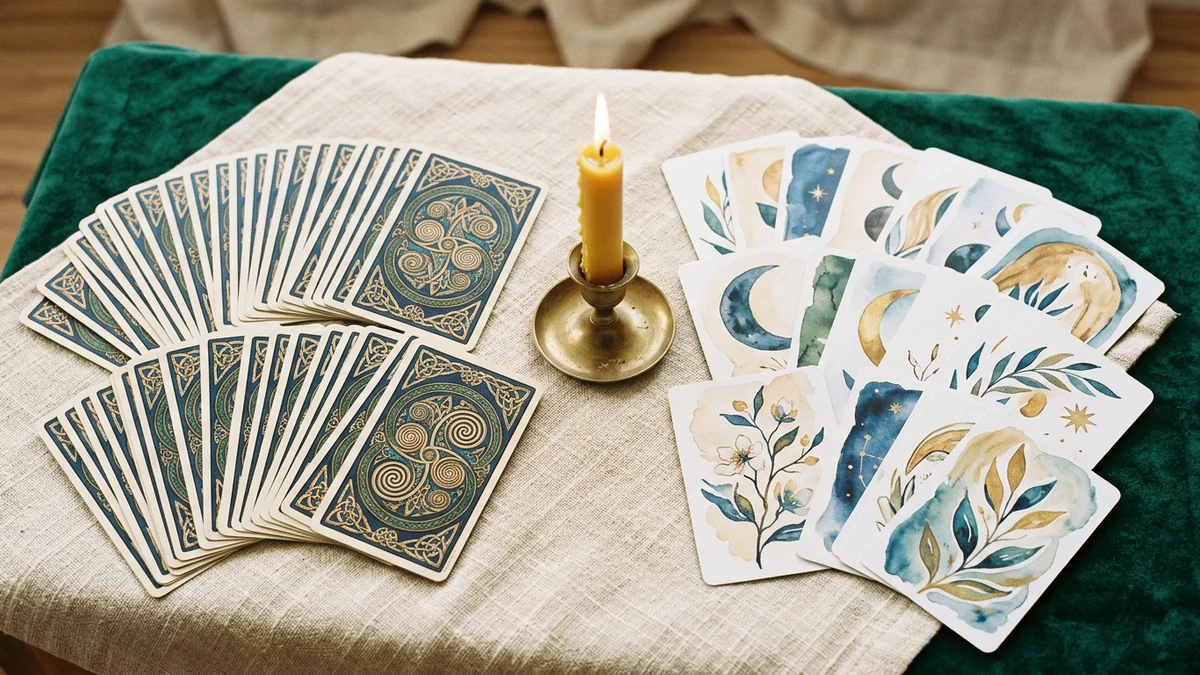
Oracle cards are the free spirits of the card world. An oracle deck can have any number of cards, any theme, and any structure its creator dreamed up. There are angel decks, goddess decks, animal decks, affirmation decks, and decks built around flowers, moon phases, or Celtic symbols.
Where tarot is a language with grammar, oracle cards are more like poetry — each card carries a single, clear message, often with the meaning written right on the card. They are direct, gentle, and immediately understandable.
The key differences at a glance
- Structure: Tarot always has 78 cards in a set system; oracle decks vary completely.
- Learning curve: Tarot rewards years of study; oracle cards can be read almost intuitively from day one.
- Depth vs. clarity: Tarot tells complex, interwoven stories; oracle cards deliver one clear, focused message.
- Tone: Tarot will show you the whole picture, including challenges; oracle decks tend toward encouragement and affirmation.
- Spreads: Tarot uses traditional layouts like the Celtic Cross; oracle cards are often drawn singly or in simple rows.
Which one is right for your question?
Here is how I think about it at my own table.
Choose tarot when you want depth and detail. If you are facing a complicated situation — a relationship with many moving parts, a career crossroads, a decision with consequences rippling in several directions — tarot's structure lets us look at the past influences, the present dynamics, the hidden factors, and the likely path ahead. Tarot is the deck I reach for when someone says, "I need to understand what is really going on."
Choose oracle cards when you want a clear, uplifting message or a gentle nudge. If you simply ask, "What do I need to know today?" or "What energy should I carry into this week?", an oracle card answers beautifully. Oracle cards are also lovely at the end of a tarot reading, to sum everything up in one encouraging thought.
Choose both when you want the full experience — and that is exactly how I often work. A tarot spread to map the territory, then an oracle card to seal the reading with a message to carry home.
Can cards predict the future?
I prefer to say that cards illuminate the path you are currently walking. They show the energies around you, the influences at play, and where the road is heading if nothing changes. That is empowering, because it means you always have a choice. A good reading does not lock you into a fate — it hands you a map and a lantern.
The future is shaped by your decisions, and the cards are there to help you make those decisions with clarity and confidence. That has been my experience across thousands of readings, and it is why I find this work so joyful.
A word about reading for yourself
Many guests ask whether they can learn to read cards themselves, and my answer is a delighted yes. I teach classes in Tarot, as well as Angels and Reiki, and there is nothing quite like watching a student pull their first card and feel it speak. If you are drawn to learn, start with a deck whose artwork you love — you will be spending a lot of time together.
Until then, there is real value in having an experienced reader hold the cards for you. An outside reader sees what you are too close to see, and brings decades of pattern-recognition to the spread. You can read more about my background on the about page.
A simple three-card spread to try at home
You can begin reading cards without memorising an entire book. A simple three-card spread gives enough structure to tell a story while leaving room for your intuition. Choose tarot or oracle cards, shuffle in whatever way feels comfortable, and think of one calm, open question.
Lay three cards from left to right. Give them these positions:
- What is present? This card reflects the energy or truth at the heart of the matter.
- What supports me? This card points toward a strength, resource, person, or helpful attitude.
- What is my next step? This card offers a practical focus rather than a fixed prediction.
Before reaching for a guidebook, look at each picture. Notice the first detail that catches your eye, the mood of the colors, and whether the figure seems to be moving toward or away from something. Write down your first impression in one sentence. Your immediate response is often more useful than trying to produce a perfect textbook meaning.
Then look across all three cards as one scene. Do colors repeat? Are the figures facing one another? Does the final card feel lighter, steadier, or more active than the first? These relationships are where the reading begins to sound like a conversation rather than three separate definitions.
If a card worries you, slow down. Tarot is not there to frighten you. Ask what lesson, choice, or invitation the card might hold. Even a challenging picture can reveal a boundary to strengthen, a habit to release, or an honest truth that creates room for something better.
Close by choosing one phrase to carry into your day. It might be “take one clear step,” “listen before deciding,” or “make room for rest.” Put the cards away with care and revisit your notes later. You may be surprised by how their message develops with time.
Caring for your cards and your confidence
There is no single correct ritual for keeping a deck. Some readers use a special cloth or box; others keep cards on a bookshelf. What matters is that the deck stays clean, complete, and easy for you to reach. Handle it often enough that shuffling feels natural.
Confidence grows through regular, low-pressure practice. Draw one card in the morning and ask what quality would support your day. In the evening, write down how its message appeared. This is not about proving a prediction. It is about learning the visual language of your deck and noticing how your intuition responds.
Try not to ask the same question repeatedly in search of a preferred answer. Give the first reading time to breathe. If circumstances change, you can return with a fresh question that reflects what is different now.
Reading for yourself can be meaningful, but it is also easy to see only what you hope or fear. When you feel too close to a situation, an experienced reader can offer a steadier perspective. You can explore a professional session on the tarot and oracle card readings page, then continue your own practice with new ideas.
What a card reading with me is like
A card reading is relaxed and conversational. You bring a question — or simply yourself — and we let the cards talk. I explain what I see as we go, in plain English, and you are welcome to ask questions throughout. Sessions are 15 or 30 minutes, in person or by phone, and yes, cards work beautifully by phone — I shuffle and lay the spread while we talk, and the cards do not mind the distance one bit.
Payment is made after your reading, by credit card, Square or Cash App, so there is never any pressure.
If you are curious about the other ways I work, have a look at psychic and medium readings, Reiki healing, or animal communication. Common questions are answered on the FAQ page.
The short version
Tarot is the deep, structured conversation; oracle is the clear, kind whisper. Neither is better — they are simply different instruments, and in practiced hands they make beautiful music together. If you would like to hear what they have to say to you, request a reading and I will call you back to schedule.